Despite its name, Tennis Elbow has very little to do with tennis for most of the patients who walk into my clinic with it. As one of the best orthopedic surgeons in Vashi, Navi Mumbai, I see this condition frequently in office workers, homemakers, painters, plumbers, and even smartphone users — anyone whose daily routine involves repetitive gripping or wrist movement. If you’ve been experiencing a persistent, burning pain on the outer side of your elbow, this blog will help you understand what’s really going on and how it can be treated effectively.
What Is Tennis Elbow?
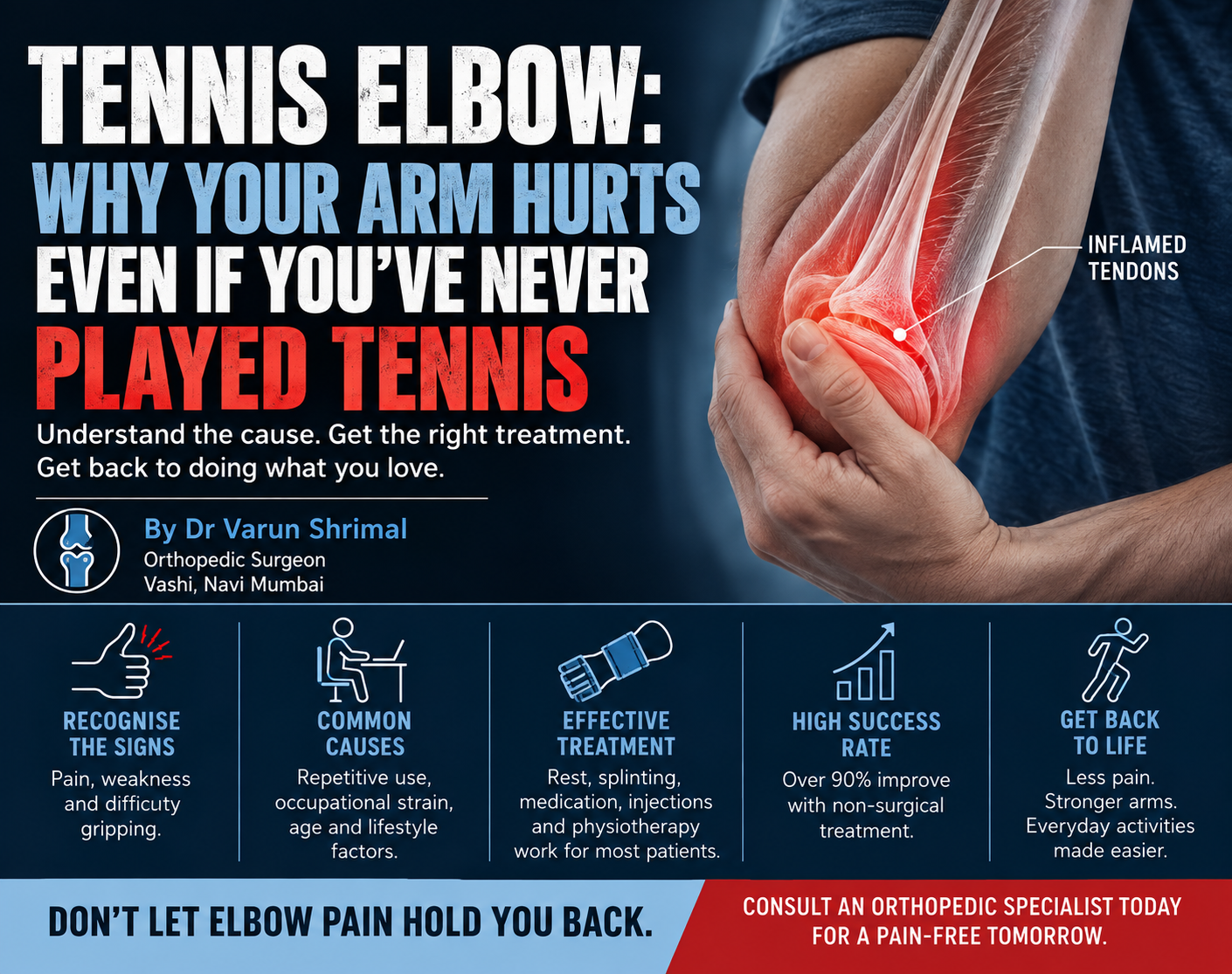
Tennis Elbow, medically known as lateral epicondylitis, is an overuse injury that affects the tendons connecting the forearm muscles to the outer bony bump of the elbow (the lateral epicondyle). These tendons are responsible for extending the wrist and fingers. Repeated stress on this area causes tiny tears in the tendon fibers, leading to inflammation, degeneration, and pain that can range from mildly annoying to debilitating.
Contrary to popular belief, only a small percentage of people diagnosed with Tennis Elbow actually get it from playing tennis. The condition is far more commonly linked to occupational and everyday activities that involve repetitive wrist extension and gripping.
Common Symptoms
Patients with Tennis Elbow typically describe:
- Pain or burning sensation on the outer part of the elbow
- Weak grip strength, making it difficult to hold a cup, shake hands, or turn a doorknob
- Pain that worsens with wrist movement, especially lifting or twisting
- Stiffness in the elbow, particularly in the morning
- Discomfort that may radiate down the forearm toward the wrist
Symptoms often develop gradually and worsen over weeks or months if the underlying activity isn’t modified.
What Causes Tennis Elbow?
The primary cause is repetitive strain, but several everyday activities and factors contribute to its onset:
- Repetitive gripping and wrist movements — typing, using hand tools, or repetitive lifting
- Poor technique in sports — including tennis, badminton, and weightlifting
- Occupational strain — carpentry, painting, plumbing, and assembly-line work
- Age-related tendon degeneration — most common between ages 30 and 50
- Sudden increase in activity — a new gym routine or an unfamiliar repetitive task can trigger symptoms even in previously unaffected individuals
How Common Is Tennis Elbow — Especially in Urban India?
Tennis Elbow affects roughly 1-3% of the general adult population worldwide, making it one of the most frequently diagnosed elbow conditions in orthopedic practice. It has been observed a steady rise of cases — largely driven by desk-bound jobs, prolonged laptop and smartphone use, and a growing fitness culture where people take up racquet sports or weight training without proper technique or conditioning.
Who’s affected most? Contrary to the name, tennis players make up only a small fraction of cases seen in clinics. The professionals most commonly affected include:
- IT and desk-job professionals — due to prolonged mouse use, typing, and poor wrist posture
- Homemakers — from repetitive activities like wringing clothes, chopping, and stirring
- Manual laborers and tradespeople — carpenters, painters, plumbers, and mechanics who grip and twist tools repeatedly
- Recreational and competitive athletes — particularly those playing tennis, badminton, and squash, or lifting weights with poor form
Age range: Tennis Elbow is most prevalent in adults between 35 and 55 years of age, with peak occurrence around the 45-54 age bracket. This is generally attributed to age-related tendon degeneration combined with decades of cumulative repetitive strain. That said, it is increasingly being seen in younger urban professionals in their late 20s and early 30s, largely linked to long hours of laptop and smartphone use. Interestingly, the dominant arm is affected in the majority of cases, reinforcing its classification as an overuse condition.
How Is It Diagnosed?
Diagnosis is usually clinical. During examination, pain is reproduced when the patient extends the wrist against resistance. In select cases, an ultrasound or MRI may be used to assess the degree of tendon damage, especially if symptoms are severe or not responding to initial treatment.
Treatment Options
The encouraging news is that the vast majority of Tennis Elbow cases resolve with conservative treatment, provided the diagnosis is made early and activity modification is followed. Studies show that over 90% of patients recover successfully with non-surgical management within one to two years, and about 80% notice meaningful improvement within the first year itself. This makes Tennis Elbow one of the more reassuring musculoskeletal conditions to treat — surgery is needed in only a small percentage (roughly 1-2%) of cases that fail to respond to a well-structured conservative program.
First-line conservative treatment includes:
- Rest and activity modification to avoid the aggravating motion
- Ice application during the acute painful phase
- NSAIDs for pain and inflammation control
- Counterforce bracing, a forearm strap that reduces tension on the injured tendon
- Physiotherapy, focusing on eccentric strengthening exercises, which have strong evidence for long-term tendon healing
- Stretching exercises for the wrist extensors to improve flexibility
- Corticosteroid injections may offer short-term relief, though effects can wear off in some patients
- Platelet-Rich Plasma (PRP) injections are gaining popularity for promoting tendon healing in chronic, resistant cases
- Extracorporeal Shockwave Therapy (ESWT) stimulates the body’s natural healing response
- Surgical intervention, reserved for the small percentage of patients who don’t respond to any conservative measures, involves removing damaged tendon tissue and reattaching healthy tissue to bone. Surgical success rates are reported to be in the range of 70-90%, offering reliable relief for long-standing, treatment-resistant cases
Preventing Tennis Elbow
If you’re at risk due to your profession or daily habits, a few precautions can go a long way:
- Warm up before repetitive or strenuous arm activity
- Use proper ergonomic tools and grips
- Take regular breaks during repetitive tasks
- Strengthen forearm muscles gradually with targeted exercises
- Correct your sports technique with professional guidance if needed
When Should You See a Specialist?
If your elbow pain persists beyond a couple of weeks, interferes with your grip strength, or keeps returning despite rest, it’s time to consult an orthopedic specialist. Early intervention leads to faster recovery and prevents the condition from becoming a chronic, harder-to-treat problem.
If you’re dealing with ongoing elbow pain and looking for the best orthopedic surgeon in Vashi, Navi Mumbai, for accurate diagnosis and effective treatment, book a consultation today and get back to pain-free movement.
![5 Warning Signs Your Child May Need an Orthopedic Doctor]](https://drvarunshrimal.com/wp-content/uploads/2026/02/5-Warning-Signs-Your-Child-May-Need-an-Orthopedic-Doctor.png)